You notice “6/7” beside Australian Wagyu and expect something special, but what does the number actually tell you? Understanding the Australian Wagyu marbling score helps you read beyond the name and choose a steak that suits your taste. In a product range, 6/7 commonly groups marble scores six and seven; it is not six out of seven or a fat percentage. At Thermo Steakhouse, the individual Wagyu dishes carry more specific descriptions, including MB6+ ribeye and MB7+ filet mignon. Here is how to interpret those details.
Australian Wagyu Marbling Score: The Short Answer
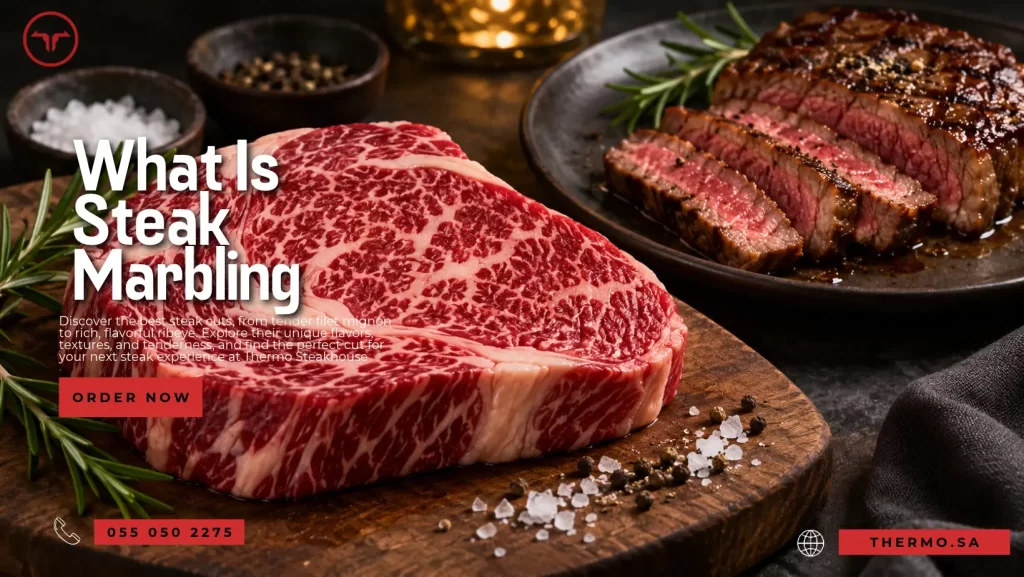
A marble score describes the visible intramuscular fat in beef: the fine flecks and streaks within the muscle. It does not measure the outer fat cap, the length of the bone, or the size of the steak.
Australia’s AUS-MEAT visual marbling scale runs from zero to nine, with 9+ also used for highly marbled Wagyu. Within that context, six and seven sit toward the more marbled end of the scale.
An Australian Wagyu marbling score is useful product information, but it is not a complete eating-quality rating. Cut, handling, aging, and cooking still influence what you experience.
What Does “6/7” Mean on a Menu?
Suppliers may group adjacent scores into commercial ranges, such as 4–5, 6–7, or 8–9. When used this way, “6/7” identifies a range covering scores six and seven rather than a separate official score called six-seven.
The exact meaning should be checked against the supplier’s specification. A restaurant might also use 6/7 as a broad introduction to multiple Wagyu options, while individual dishes have their own labels.
Read an Australian Wagyu marbling score alongside the specific dish description. If the main page says 6/7 but the ribeye says MB6+, use that dish’s information as your starting point and ask the team to explain the product specification.
Does 6/7 Mean Six Out of Seven?
No. The slash is not necessarily a fraction, and seven is not the maximum of the Australian scale. It should not be read like a review score or a percentage.
Similarly, MB6+ and MB7+ should not automatically be treated as identical to a 6–7 product band. A “+” label may indicate a minimum specification within a supplier’s program; confirm its meaning for the beef being offered.
How the Marbling Score Is Assessed
Qualified graders compare the exposed muscle at a specified carcass assessment site with reference standards. This creates a more consistent description than judging a steak from an advertising photograph.
The Australian Wagyu marbling score shown on a product relates to that grading context. It does not mean someone has independently scored every individual steak in the dining room.
Different muscles can show different amounts and patterns of fat, even when they come from the same carcass. A producer may pack cuts under a carcass-based grade while the appearance of those cuts varies.
This is one reason a tenderloin does not need to look exactly like a ribeye carrying a similar designation.
AUS-MEAT and MSA Are Different Systems
Australia also uses MSA marbling assessment. Although both systems concern intramuscular fat, they use different criteria and numerical scales.
AUS-MEAT describes the amount of visible marbling on its reference scale. MSA marbling uses a finer range, from 100 to 1,190 in increments of ten, and considers distribution as well as amount.
When comparing an Australian Wagyu marbling score, identify the system first. A number from one scale cannot simply be read as the same number on another.
| Label or system | How to read it |
| AUS-MEAT marble score | Visual marbling scale from 0 to 9, with 9+ used for high-marbling Wagyu |
| MSA marbling | Separate, finer assessment using scores from 100 to 1,190 |
| Commercial 6–7 band | A supplier’s grouping of adjacent marble scores |
| MB6+ or MB7+ | Product wording that needs the supplier’s specification for precise interpretation |
What a Score of 6 or 7 Suggests About the Meat
Within the same grading system, higher scores indicate more marbling at the assessment site. A six or seven, therefore, suggests a more marbled product than a lower-scoring one, all else being comparable.
That can contribute to a richer mouthfeel and the perception of flavor and juiciness. However, the Australian Wagyu marbling score does not guarantee a particular sensation in every bite.
Some people enjoy a pronounced fatty richness; others prefer a more restrained experience. The best choice depends on your preferences as well as the cut.
Think of the score as a useful description, not an instruction to choose the highest number available.
Why Tenderness Is Not Just a Number
Tenderness means how easily the meat can be chewed. It depends on more than intramuscular fat, including the muscle itself and how the beef has been handled and prepared.
A higher Australian Wagyu marbling score does not automatically make every cut more tender than every lower-scoring cut. Comparing a tenderloin with a ribeye introduces a cut difference as well as any difference in marbling.
If tenderness is your priority, tell the team that directly. They can discuss the available cuts rather than relying on the score alone.
Is MB6 the Same as 6% Fat?
No. The Australian Wagyu marbling score is not a direct percentage of intramuscular fat. An MB6 product should not be interpreted as containing exactly six grams of fat per hundred grams of steak.
Some assessment technologies measure marbling percentage separately. That is different information from a visual score, even when both appear in a product report.
The Australian Wagyu marbling score also does not tell you the total fat in your finished meal. Portion size, external fat, sauces, butter, and side dishes can change the plate considerably.
For diners, the simplest approach is to keep “score” and “percentage” separate.
How Does the Australian Scale Compare With Japanese A5?
Japanese beef grading uses a different structure. Its Beef Marbling Standard ranges from one to twelve, while an A5 designation combines a yield grade with a meat-quality grade.
The “A” concerns yield, and the “5” relates to quality assessed using several characteristics, including marbling. It is not another way to write an Australian score of five.
Avoid converting an Australian Wagyu marbling score of six or seven into A4 or A5 using a simple online equivalence chart. Different standards should be understood on their own terms.
This distinction helps you interpret labels; it does not mean a restaurant offering Australian Wagyu also serves Japanese Wagyu.
Does the Score Tell You the Wagyu Breed Percentage?
No. Breed content and marbling are separate pieces of information. The score does not establish whether a product is full-blood, purebred, or crossbred.
Genetics and feeding contribute to marbling, but the final assessment describes the beef rather than providing a pedigree certificate.
When reading an Australian Wagyu marbling score, avoid using it to infer information that has not been supplied. If breed content matters to your choice, ask about the producer and the product’s documented description.
Likewise, Australian origin identifies a production context; it does not guarantee the same score for every Wagyu product.
Applying the Numbers to Thermo’s Wagyu Dishes
At Thermo Steakhouse, the published English menu lists two Australian Wagyu options with individual marbling designations.
These dishes give you a practical way to connect the Australian Wagyu marbling score with your choice of cut and portion. Read all three details together rather than choosing by the number alone.
Wagyu Ribeye, 10 oz: MB6+
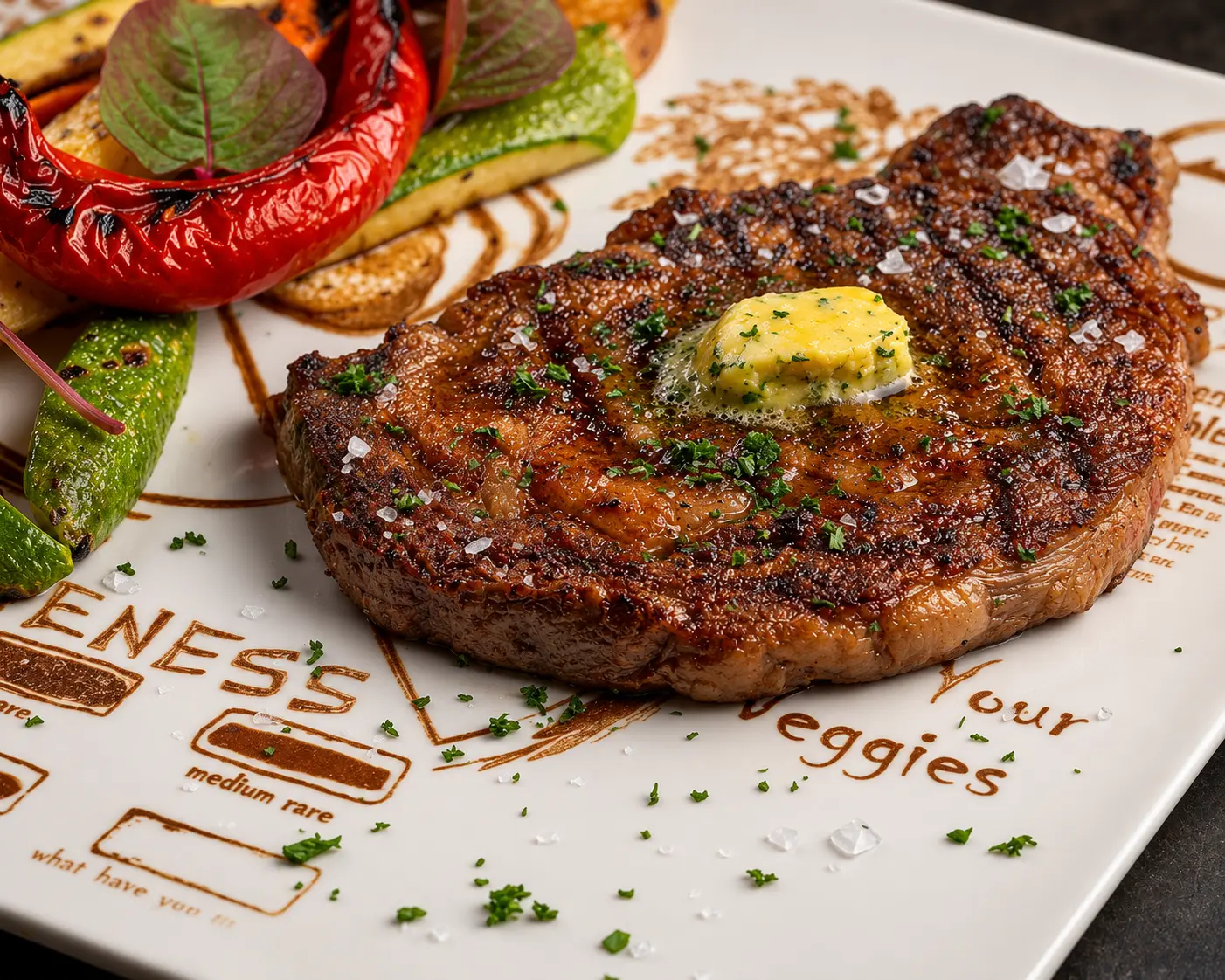
The Wagyu Ribeye, 10 oz is described as Australian Wagyu with an MB6+ designation.
If you enjoy ribeye and want to explore a marbled Wagyu option, this is a dish to discuss with the team. Ask about its expected richness, preparation, and accompaniments.
The published designation is MB6+, so do not assume the broader 6/7 wording means every ribeye is specifically grade seven.
Wagyu Filet Mignon, 7 oz: MB7+
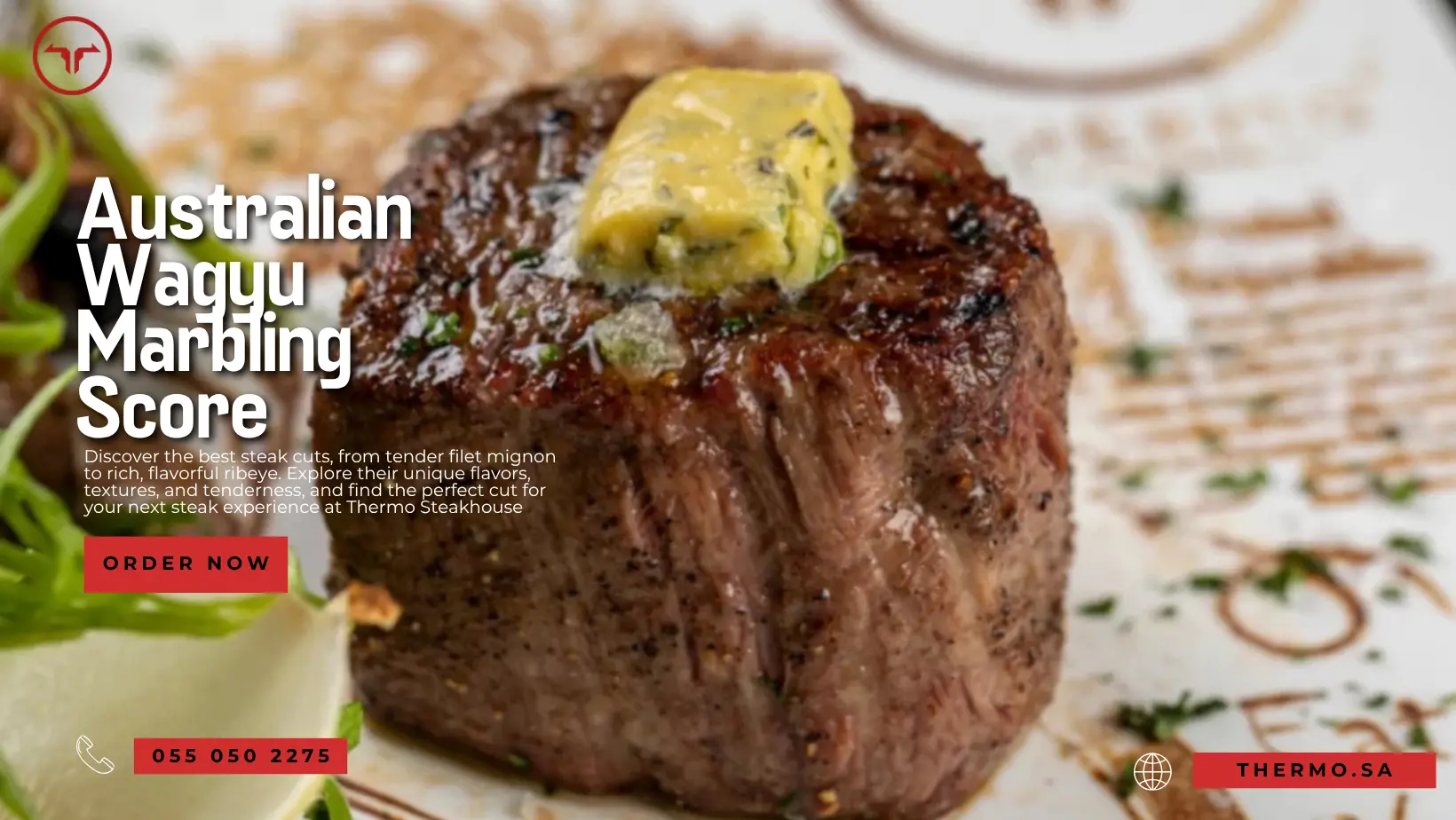
The Wagyu Filet Mignon, 7 oz is listed as Australian Wagyu tenderloin with an MB7+ designation.
It combines a different cut with a different listed specification and portion size. Its appearance and eating texture should not be expected to match the ribeye.
An Australian Wagyu marbling score helps describe each option, but it does not make these two dishes a controlled comparison. Choose according to the whole description and your preferences.
Four Questions That Make Ordering Easier
You do not need to become a beef grader before booking dinner. A few clear questions can help you understand what the menu offers:
- Which grading system does this label use? Establish the scale before comparing numbers.
- What does the “+” mean for this product? Ask about the supplier’s specification.
- Which cut matches my preferences? Explain whether you favor tenderness, richness, or less noticeable fat.
- What comes with the dish? Confirm the portion, sides, sauces, and current availability.
Use the Australian Wagyu marbling score to support that conversation. It is most useful when it helps you describe the experience you want rather than replacing the rest of the decision.
Choose Your Wagyu Experience at Thermo
A 6/7 label commonly points to a commercial band covering marble scores six and seven. It does not mean six out of seven, a fat percentage, or an automatic Japanese grade.
The Australian Wagyu marbling score becomes more useful when you combine it with the cut, product specification, and your own taste.
Explore the Thermo menu, compare the Wagyu ribeye and filet mignon descriptions, and contact Thermo Steakhouse to confirm availability and arrange your visit. Find Thermo Steakhouse on Google Maps and plan a meal around the steak you would most enjoy.
Frequently Asked Questions
Is an Australian Wagyu Marbling Score of 6 or 7 Good?
It indicates a relatively well-marbled product within the AUS-MEAT context. Whether it is right for you depends on the cut and your preferred richness. A higher number is not automatically a better personal choice.
Is 6/7 the same as MB6+?
Not necessarily. A 6–7 band groups adjacent scores, while MB6+ is a product designation whose exact meaning depends on the supplier’s specification. Ask for clarification rather than treating the labels as interchangeable.
Can I Judge the Score From a Steak Photograph?
A photograph may show visible fat, but it cannot replace a grading assessment. Lighting, temperature, the muscle photographed, and image processing affect appearance. Use the documented product specification instead of assigning a score yourself.
Does a Higher Score Determine the Correct Doneness?
No. Cut, thickness, cooking method, and personal preference still matter. Explain how you like your steak and ask for advice about the selected dish rather than assigning a fixed doneness to each score.
Does Marbling Increase During Dry Aging?
Dry aging does not create new intramuscular fat. The marbling develops in the animal, while aging happens after slaughter. These terms describe different features and should be considered separately when reading a menu.